Blogging
Blogs are websites in which regular entries (usually daily or weekly) are displayed in reverse chronological order (newest first). Regardless of the topic, blogs almost always contain some sort of commentary and some blogs also include images, video, or audio.
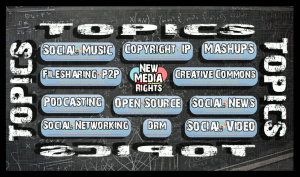
Creative Commons
Creative Commons and other Open Source licenses give copyright holders the flexibility to choose what rights they wish to reserve regarding their content and the type of permission required to copy, reproduce, share, or form derivative works based on that content. Creative Commons and Open Source licenses are generally much less restrictive than traditional copyright licenses, and help to increase the amount of creative work in the public domain.
Digital Rights Management (DRM)
Digital rights management (DRM) refers to restrictive technology used by copyright holders to limit usage of digital media or other devices.
Filesharing/P2P
Peer-to-peer filesharing allows users of separate computers to exchange files over the Internet. Filesharing generally entails both uploading and downloading but some networks do not require all users to upload files. Popular filesharing clients include Napster, Kaza, and BitTorrent.
Mashups
Mashups are web applications that combine two or more sources of data to form a unique, integrated application. Content is usually drawn from public sources and might consist of a mix of map data, RSS feeds, images, video, blogs, or other things.
Open Source
Open Source licenses (like Creative Commons) give copyright holders the flexibility to choose what rights they wish to reserve regarding their content and the type of permission required to copy, reproduce, share, or form derivative works based on that content. Open Source licenses are generally much less restrictive than traditional copyright licenses, and help to increase the amount of creative work in the public domain.
Podcasting
Podcasts are audio or video files that are distributed over the Internet and made available for syndication or subscription via RSS (Really Simple Syndication) feeds. Because podcasts are often available as mp3s, they can easily be put onto portable media devices for listening.
RSS
RSS most commonly stands for Really Simple Syndication and is a format of Internet feed used to publish frequently updated content. When used with an rss aggregator, RSS feeds can be subscribed to and automated so that websites do not need to be visited manually for updates. RSS is a typical feature of "web 2.0" websites like blogs, podcasts, and social media sites and offers another method of delivery of content and information without a direct visit to the website.
Social Bookmarking
Social bookmarking allows users to store links to web pages online, as opposed to traditional browser bookmarking which stores information on your hard drive. Social bookmarking services frequently make user bookmarks public, where users can search the bookmarks of others and share their own bookmarks with the community. And through the use of tags, users can organize their own bookmarks or find bookmarks in the community related to a specific topic.
Social Music
Social music sites allow users to stream or download music on the Internet. Some sites function like radio stations where the user cannot select a specific song to play. Other sites let you search for and listen to artists and songs without restraint.
Social Networking
Social networks are online communities of people with shared interests, hobbies, or causes. Social networking websites provide users with an array of communication tools, which include: instant messaging, text chat, forums, discussion groups, email, blogging, file sharing, images, video, and games.
Social News
Social news sites are a form of participatory media in which users in the community determine the website's content. News articles, blogs, videos, and podcasts are posted and rated by members of the community with the highest rated content being displayed most prominently on the site.
Social Video
Social video services allow users to upload, view and share video clips on an Internet website. Depending on the site, content can include: movie clips, TV clips, music videos, instructional videos, grassroots media, and other amateur content such as videoblogging and short original videos. Learn more