 The United States Copyright Office recently published its final rule for implementation of the procedures that are to govern the initial stages of a Copyright Claims Board (CCB) proceeding. The CCB will be a new forum where copyright small claims disputes can be heard.
 New Media Rights recently received a $20,000 grant from Grant for the Web to support Grant for the Web recipients and others on the boundaries of web monetization with legal services. This grant is a continuation of our work with web monetization innovators last year, and we are thrilled to be continuing our work with the Grant for the Web community! The grant is a partnership with
  We're proud to announce a new legal guide!
 Assistant Director Shaun Spalding is speaking at the Vlog Summit Social Media Convention on Saturday, August 25, 2018. He'll be speaking about copyright and licensing for online video creators and personalities.
 We're honored to have been invited to speak at PLI's "Fundamentals of Copyright Law in the Data Era."
As we've written about before there's a major justice gap when it comes to creators and entrepreneurs having access to critical legal services. While we do our best to provide free and low cost legal services, we’re only one organization. That's why we’ve created a national list of law school legal clinics as a resource to creators, entrepreneurs and even other lawyers to help find other legal clinics fighting to fill the justice gap. The clinics on the list typically provide completely free or low cost services depending on if you qualify and they have the capacity to take on new issues. Check out the complete list here.

Learn about our services
Learn about our legal services for: App Developers, Artists & Graphic Designers, Bloggers & Journalists, Clothing Designers, Entrepreneurs, E-commerce Business People & Startups, Filmmakers & YouTube creators, Public Broadcasting producers,Game Developers, Internet users & Smartphone users, Makers, Musicians, Non-Profits, Photographers, Scholars, Researchers, and Writers and Publishers.
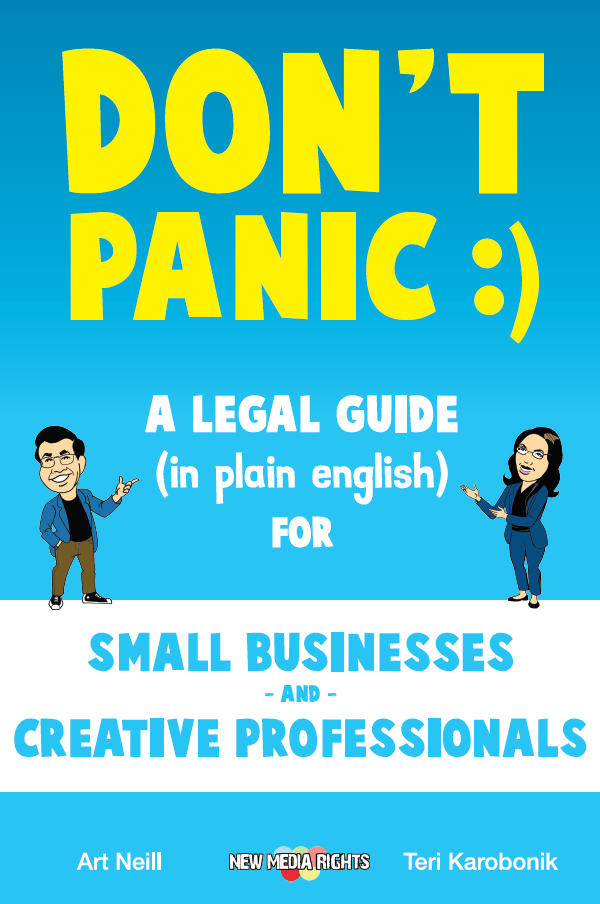 In our new book, we focus on issues you may encounter from the inception of your business to the moment (that hopefully doesn’t happen) you get a nasty lawyer letter for the first time.
You’ll learn how to form your business, protect your intellectual property, and avoid problems when launching your project. Taking a few simple steps upfront to protect your business or project can save time and money down the road. Don't Panic has also been used in undergraduate & graduate classes nationwide to teach business and legal concepts to non-lawyers. Professors can request a FREE evaluation copy
CHOOSE YOUR FORMAT
